Infrastructure
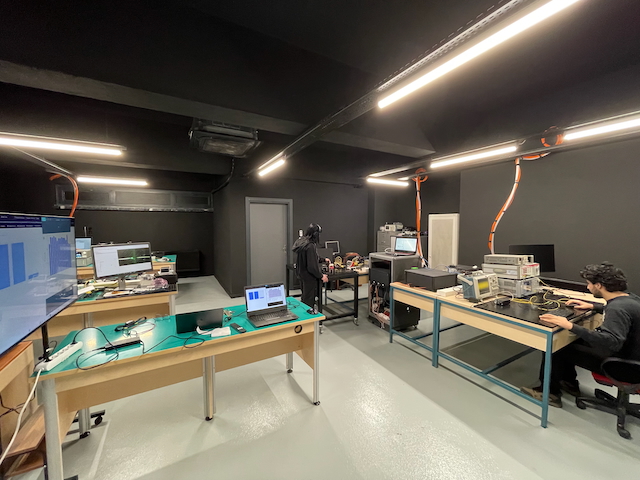
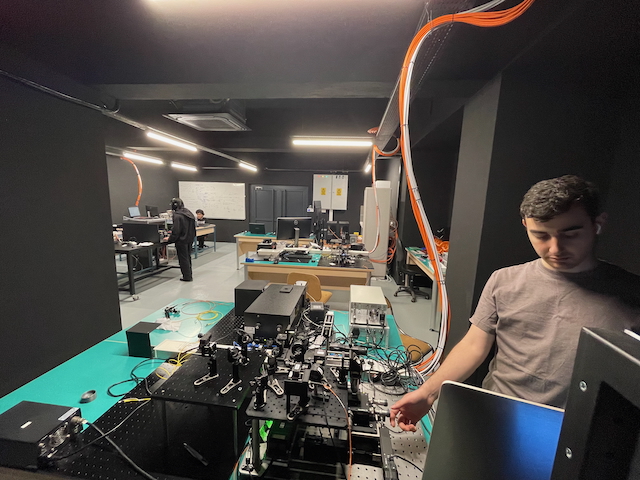
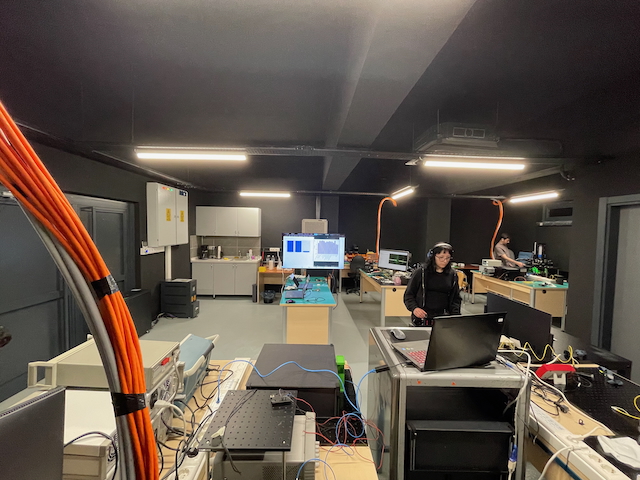
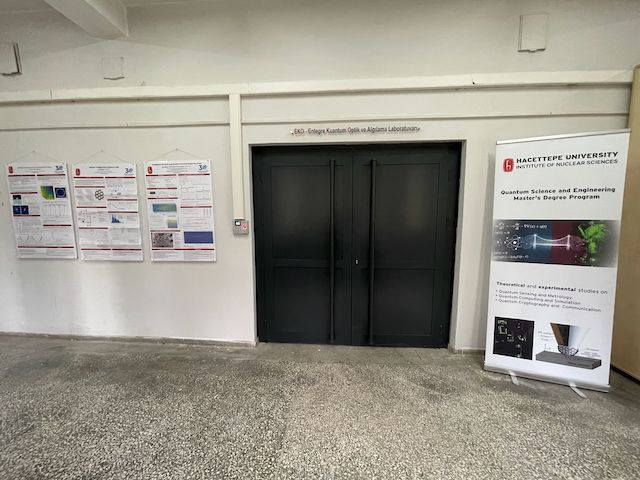
Research Topics
Integrated Quantum Photonics
Quantum technologies including quantum computing, quantum communication, and quantum sensing are rapidly progressing toward practical systems. Among the most promising enabling platforms is quantum photonics, which allows the manipulation and control of quantum states of light within scalable optical architectures.
Integrated quantum photonics enables the miniaturization and co-integration of photonic devices such as quantum light sources, waveguides, beam splitters, modulators, and detection systems on a single chip. This approach makes it possible to develop compact and scalable quantum optical systems for communication, sensing, and information processing.
Our research focuses on the design and optimization of micro- and nano-photonic devices for integrated quantum technologies, including nonlinear optical structures, resonators, and photonic circuits that enable efficient light-matter interactions.
Quantum Light Sources
Reliable generation of non-classical states of light is a key component of many quantum technologies. Our work investigates quantum light generation mechanisms based on both deterministic (defect centers, q-dots) and nonlinear optical processes such as spontaneous parametric down-conversion (SPDC) and spontaneous four-wave mixing (SFWM).
We study both bulk and integrated implementations of photon-pair sources, including cavity-enhanced generation in microresonators, nonlinear waveguides, and engineered photonic structures designed to enhance nonlinear optical interactions.
These devices enable the generation of single photons and entangled photon pairs required for quantum communication, photonic quantum information processing, and quantum sensing applications.
Quantum Communication
Quantum communication technologies exploit the principles of quantum mechanics to achieve secure information transfer. In particular, quantum key distribution (QKD) enables cryptographic security based on fundamental physical laws rather than computational assumptions.
We investigate photonic implementations of quantum communication systems including quantum random number generation (QRNG) and quantum cryptography. Our work includes both discrete-variable and continuous-variable approaches for generating genuine quantum randomness.
Current research directions include compact QRNG architectures, high-rate randomness generation methods, and photonic platforms for practical quantum communication systems.
Quantum Sensing
Quantum sensing exploits quantum coherence and correlations to achieve measurement sensitivities beyond classical limits. These techniques can be applied to sensing magnetic fields, electric fields, temperature, pressure, and other physical quantities.
Our work includes both passive and active quantum sensing platforms. Passive sensing approaches focus on detecting weak signals using solid-state quantum systems such as color centers in diamond and hexagonal boron nitride.
Active quantum sensing explores the use of engineered quantum states to enhance measurement performance and detection capabilities in photonic sensing architectures.